
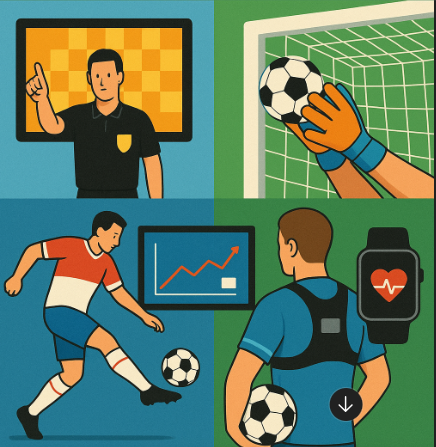
Soccer has always been called the beautiful game because of its passion and unpredictability. But in today’s world, technology is adding a new layer to how it is played, watched, and enjoyed. Platforms like 22Bet even show how technology is influencing how fans interact with matches beyond the field. Whether it is helping referees make fair decisions, giving players better ways to train, or bringing fans closer to the action, technology is quietly but powerfully reshaping every corner of the sport.
How Video Assistant Refereeing Changed The Game
Few things in football have caused more debate than Video Assistant Refereeing, or VAR. It mixes football’s technology with human judgment. VAR reduces human error by reviewing key moments. Referees check incidents using multiple camera angles and slow-motion replays. They no longer rely on split-second decisions for big calls. Penalties, red cards, and goals now receive extra confirmation. Before VAR, unfair decisions could not be changed. Players and fans often felt cheated. VAR still has issues but improves fairness. Errors can now be fixed. The game pauses briefly for reviews. Many accept this as a fair trade. Players also behave differently now. They know every action is captured from every angle. Fouls and reckless tackles have decreased. Overall misconduct has gone down because of VAR.
Goal Line Technology and Its Accuracy
Before VAR, another breakthrough solved a big problem. Did the ball cross the line or not? Goal line technology answered that question. It uses high-speed cameras or magnetic sensors. When the ball fully crosses the line, referees get an instant alert. Their watch vibrates immediately. This ended debates over unclear goals. The 2014 FIFA World Cup showed its value. Crucial goals were awarded without dispute. Players trust the system because their efforts are judged fairly. Fans also have certainty about what happened. The controversy over decisive goals has mostly disappeared. In a sport where one goal matters most, accuracy is everything.
Wearable Tech Boosting Player Performance
Referees aren’t the only people being assisted by technology. How players train and maintain fitness is also undergoing a change. Leading clubs now use special devices that track wearers’ heart rates, distances covered, sprint speeds, and even muscle strain. Such small devices are used during training and sometimes during matches. The information earned is very useful to coaches as it helps them develop customized training plans per player that minimize injury and boost performance. In modern soccer, the pace is higher as well as the physical demands. Players sustain fatigue after greater work. This is another reason modern soccer is more demanding: players exhibit top level performance for longer, which is what keeps fans glued to the nonstop, heart-pounding action.
Data Analytics Driving Smarter Strategies
Numbers are changing the way coaches think about the game. Data analytics allows teams to analyze thousands of details from every match – passing patterns, shot accuracy, defensive positioning, and more. Heat maps show where a team spends most of its time on the pitch, while predictive models suggest the best ways to break down an opponent’s defense. This has turned preparation into a science. Teams that once relied solely on instinct now back up their strategies with solid evidence. For fans, this also means more competitive games, as even underdog teams can use data to find weaknesses in bigger opponents.
Enhancing The Fan Experience Worldwide
At the heart of soccer are the fans. New technologies are greatly improving how they connect with the sport. High definition transmissions show everything clearly. Fans can see a striker’s faint effort while dribbling. They notice the subtle tilt of a winger’s pass. Supporters no longer depend on one viewing angle. Instant replays give them every perspective. Large display screens in stadiums show replays within seconds. This keeps everyone updated. Soccer clubs are exploring virtual and augmented reality. These allow fans to experience games from incredible perspectives. They can even enjoy them from home. Social media has also changed engagement. Fans and players exchange messages. Behind-the-scenes content and live relaxed moments are shared. For many supporters, this makes the sport more engaging. It feels closer and more approachable than ever.
What The Future Holds For Soccer Technology
The impact of technology on soccer is still growing. Referees will soon have access to even more advanced decision-making tools. Artificial intelligence might help analyze player movements in real-time to detect fouls automatically. Stadiums may become fully interactive, where fans can customize what they see on their screens while watching live matches. Training will become even more scientific, with AI-powered systems predicting injuries before they happen.
The purpose of technology in soccer is certainly not to diminish the spirit of the sport but to advance and enhance it. Games can be more just, teams can be more efficiently trained, and fans can engage with the sport on a whole new level.
Conclusion
Consider the evolution of goal-line technology and the introduction of VAR for offside decisions. Now we have data-driven analysis of player performance and strategies. What started with pure athletic competition has embraced every aspect that can bring fairness, excitement, and a little bit of science to the beautiful game. Soccer continues to develop and modernize as it maintains the features that define it. The future of soccer is undoubtedly bound to be influenced by technology, but at the core, the affection and zeal for the sport will persist.
COMMENTS