
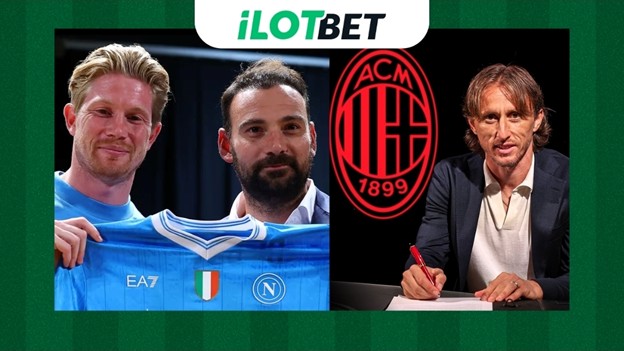
When SSC Napoli unveiled Kevin De Bruyne and AC Milan moved for Luka Modrić, the reaction across Europe was immediate and divided.
On one hand, these are generational midfielders. De Bruyne, one of the defining creators of the Premier League era, and Modrić, a Ballon d’Or winner and the cerebral heartbeat of Real Madrid’s most recent dynasty, bring gravitas, intelligence and global recognition. On the other hand, both are well into their thirties. Neither transfer represents a league cornering the market on football’s future. They feel, instead, like carefully curated echoes of past greatness.
That duality captures the modern tension within Serie A. Is Italy rebuilding through experience and tactical refinement, or is it becoming a high-end finishing school for players exiting their physical peak?
In the 1990s and early 2000s, Serie A did not wait for superstars to age. It signed them at their apex. Ronaldo Nazário arrived at Inter at 20. Zinedine Zidane joined Juventus at 24. Kaká was 21 when Milan secured him. Italy was the destination, not the final chapter.
De Bruyne’s move to Naples and Modrić’s arrival in Milan feel different in tone, even if they may prove decisive on the pitch. They are footballing intellectuals whose understanding of space and tempo can age gracefully. But structurally, they underline a broader truth: Serie A’s economic power no longer allows it to consistently win bidding wars for elite players in their prime against the Premier League or La Liga’s giants.
Italian clubs have increasingly leaned on free transfers, experienced internationals and internal reshuffling. The financial chasm created by television revenue disparities is well documented. English clubs operate within broadcast ecosystems worth several billions annually. Serie A’s total revenue remains significantly lower, restricting wage ceilings and transfer agility.
Related: Arsenal Ahead Of Liverpool, Man United In Race For Premier League Star Winger
The result is a league that often shops for value rather than for inevitability.
The clearest external measurement of league strength remains European performance. No Italian club has won the Champions League since Inter Milan completed their treble in 2010. Sixteen years without Europe’s top prize is a drought that would once have been inconceivable in Italy.
There have been near misses. Juventus reached finals in 2015 and 2017. Inter returned to the showpiece stage in 2023 and again in 2025. But near misses do not rewrite history; they merely soften it.
More troubling, perhaps, are nights that expose structural fragility. Inter’s recent elimination from European competition at the hands of FK Bodø/Glimt, a club operating on a fraction of the Italian giants’ budgets, was not simply an upset. It was a symbolic moment. Bodø/Glimt’s aggressive pressing, athletic tempo and modern recruitment model contrasted sharply with an Italian side that appeared tactically coherent but physically stretched.
Such results are not isolated flukes; they reflect how mid-tier and even smaller European clubs have narrowed the gap through analytics-driven recruitment and dynamic squad building. Italian football’s tactical IQ remains high, but the physical and developmental edge it once enjoyed has been eroded.
Since Juventus’ nine-year title run ended in 2020, Serie A has produced a different champion each season. At first glance, this suggests competitive health. Unpredictability sells.
But sustained excellence is the truer measure of strength. Dominant teams are not inherently bad for leagues; they raise standards, set benchmarks and push rivals to innovate. When no club can defend the title, the question becomes whether parity reflects balance, or shared limitations.
The domestic carousel extends beyond trophies. Coaches move frequently between rivals. Players circulate within the same ecosystem. Tactical systems feel familiar, often variations on established Italian frameworks rather than radical departures. Continuity has virtues, but insularity has costs.
The decline in sustained club dominance has paralleled turbulence for the Italy national football team. The Azzurri failed to qualify for the 2018 and 2022 World Cups, a staggering outcome for four-time champions. Youth production remains strong in pockets, yet the volume of Italian players commanding central roles at Europe’s elite clubs has thinned.
It would be simplistic to blame club recruitment strategies alone for national team struggles. Development structures, grassroots investment and broader economic realities all play a part. But when domestic clubs prioritise short-term experience over long-term cultivation, pathways inevitably narrow.
Is “retirement league” fair?
The phrase is provocative and, perhaps, unfair in its absolutism. Serie A still produces tactical sophistication unmatched in many quarters. Napoli’s recent resurgence, Milan’s rebuild, and Atalanta’s progressive recruitment show that innovation is possible within constraints.
Moreover, De Bruyne and Modrić are not symbolic tourists. They remain capable of dictating elite matches through intelligence and technique. Italy may well benefit from their presence.
Yet perception matters. When the league’s headline acquisitions are veterans rather than 23-year-old global prospects, narratives form. When European trophies remain elusive and unexpected eliminations punctuate campaigns, those narratives gain traction.
The core issue is not age but timing. Are these signings the final pieces of ambitious, forward-looking projects? Or are they short-term patches masking structural hesitation?
Serie A stands at a crossroads. Its identity, tactical, cultural, historical, is intact. Its prestige, however, requires renewal. Infrastructure reform, youth investment and commercial boldness must accompany the romantic appeal of storied names.
Italian football has reinvented itself before. The question now is whether it will do so proactively, or whether it will continue to rely on yesterday’s brilliance to illuminate tomorrow.
For those convinced that Serie A is primed for resurgence, or for those predicting further upheaval, iLOTBET offers competitive odds on Italy’s biggest fixtures, along with generous bonuses and exciting giveaways.
COMMENTS